Korea’s crypto tax: 22% above KRW 2.5 million, and losses do not carry forward
Under current law, South Korea starts taxing crypto gains on 1 January 2027. Income above KRW 2.5 million a year is taxed at 22%, only the excess is taxed, and a loss cannot be carried into the next year or set against stock gains. This page walks through each rule with worked numbers, a calculator, and where the fourth postponement debate stands.
The headline numbers
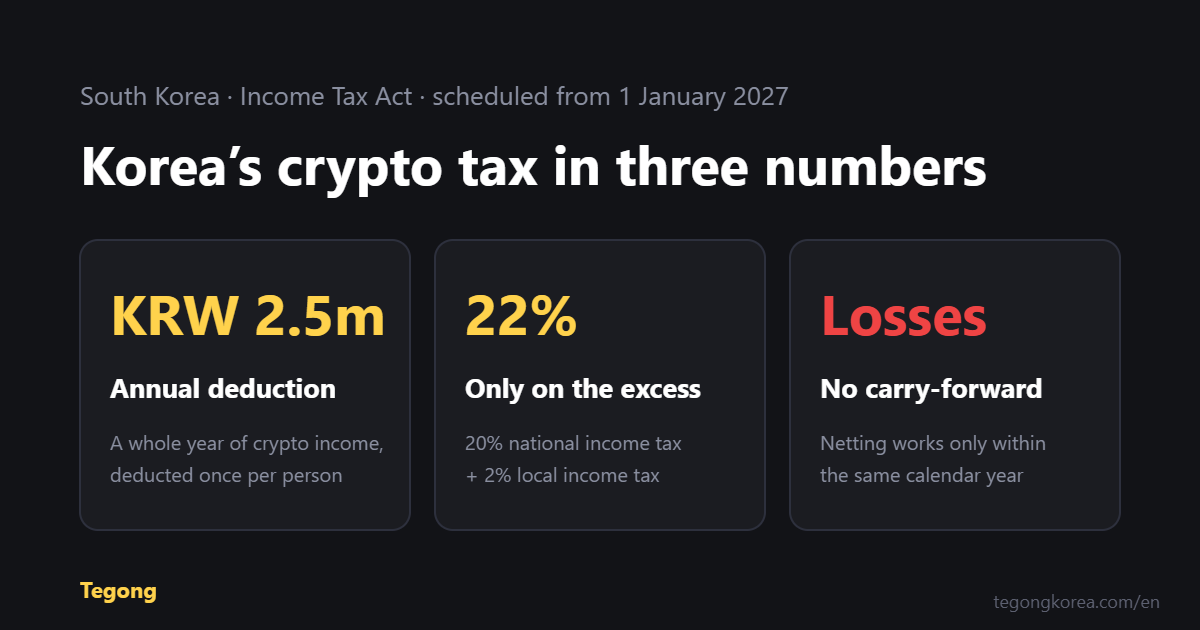
| Item | Detail |
|---|---|
| Start date | Disposals on or after 1 January 2027, under the Income Tax Act |
| What is taxed | Selling, swapping or lending crypto assets |
| Classification | Other income, taxed separately from all other income |
| Annual deduction | KRW 2,500,000 per person (roughly US$1,800) |
| Rate | 20% national plus 2% local = 22% on the amount above the deduction |
| Losses | Netted within the calendar year only; no carry-forward |
| Pre-2027 holdings | Cost = the greater of actual cost and the 31 December 2026 market value |
| First filing | May 2028, covering 2027 |
Estimate your own tax
Enter each asset you disposed of in one calendar year. The calculator nets gains and losses, takes off KRW 2.5 million and applies 22%. The example already filled in nets a KRW 6 million bitcoin gain against a KRW 3 million altcoin loss, giving KRW 3 million of income and KRW 110,000 of tax.
Korea crypto tax calculator
Current Income Tax Act · amounts in KRWAdd every crypto asset you disposed of in the same calendar year. Gains and losses are netted, KRW 2.5 million is deducted from the total, and 22% applies to the rest. The figures already filled in are an example.
The greater of actual cost and the 31 Dec 2026 market value is used.
Actual purchase cost is used.
- If you bought the same asset several times or on several exchanges, enter the annual average cost (total-average method).
- Swapping one crypto asset for another, including for USDT, counts as a disposal. Enter the market value at the time of the swap as proceeds.
- Under current law this applies to income from 1 January 2027; deferral bills before the National Assembly could move the start date. Illustrative only, not tax advice.
1. 22% applies only to the amount above KRW 2.5 million
The most common misreading is that crossing KRW 2.5 million triggers 22% on the whole gain. It does not. Only the excess is taxed.
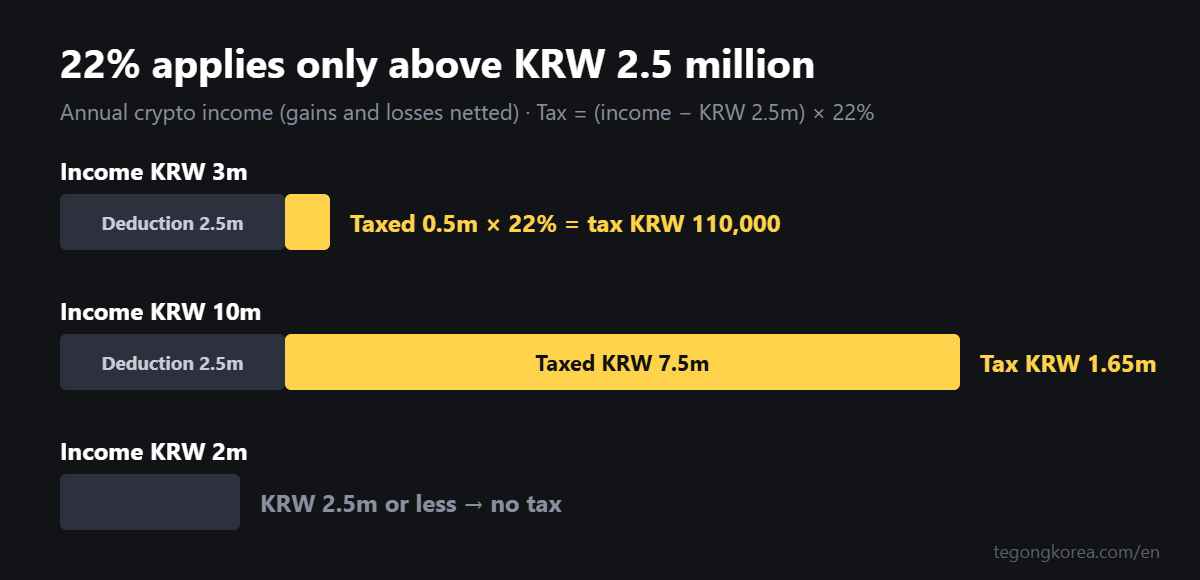
- Annual crypto income KRW 2 million → no tax
- KRW 2.5 million → no tax
- KRW 3 million → (3m − 2.5m) × 22% = KRW 110,000
- KRW 10 million → (10m − 2.5m) × 22% = KRW 1,650,000
- KRW 50 million → (50m − 2.5m) × 22% = KRW 10,450,000
The deduction is not per coin or per exchange. All crypto income a person earns in the year, across domestic exchanges, offshore venues and private wallets, is added together and the deduction is taken once.
2. Losses: netted within the year, never carried forward
“Crypto losses don’t count” is only half right. There are three different situations.
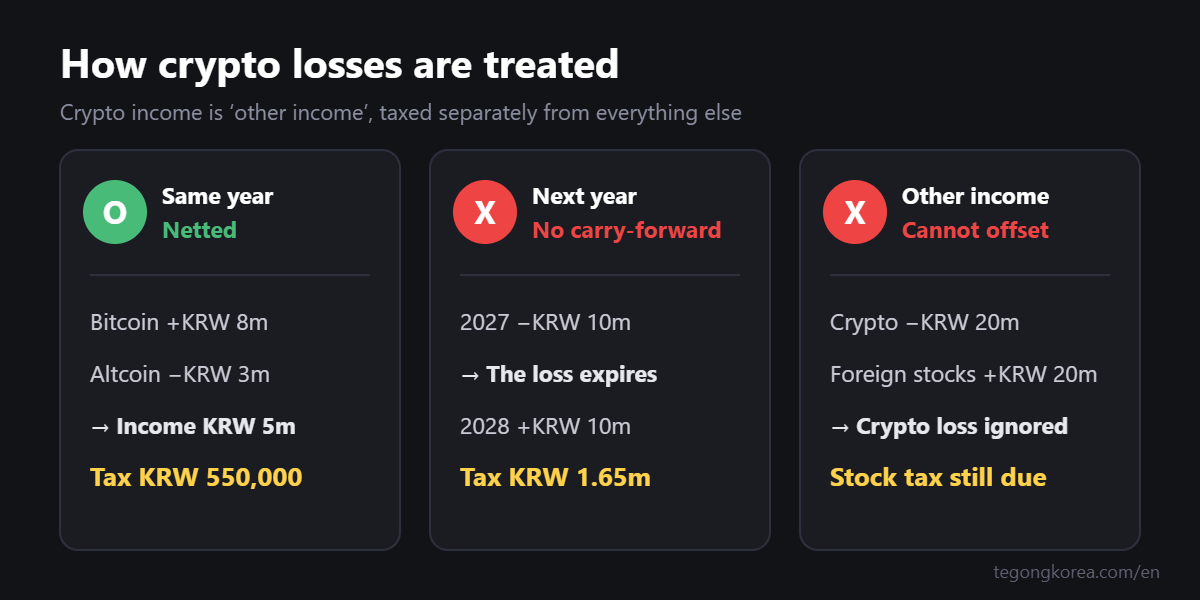
Within the same year: netted
A KRW 8 million bitcoin gain and a KRW 3 million altcoin loss in 2027 give KRW 5 million of income: (8m − 3m − 2.5m) × 22% = KRW 550,000.
Into the next year: not allowed
Lose KRW 10 million in 2027 and gain KRW 10 million in 2028, and the two years net to zero, but tax is still due. The 2027 loss simply expires; 2028 is taxed at (10m − 2.5m) × 22% = KRW 1,650,000. Unlike stock capital-gains regimes in many countries, there is no multi-year carry-forward. The gap has been raised in the National Assembly; the government’s position is that it will consider changes after the tax takes effect.
Against other income: not allowed
Because crypto income is taxed separately, a KRW 20 million crypto loss does nothing to reduce tax on a KRW 20 million gain from foreign shares. The stock tax is paid in full.
3. Swaps are taxable even if nothing is cashed out
A disposal includes exchanging one crypto asset for another. Converting ether into USDT, or rotating an altcoin into bitcoin on a BTC market, realises the gain at the market value at that moment. Ether bought for KRW 20 million and swapped for USDT when worth KRW 50 million produces KRW 30 million of income, with no won in hand. The more often a holder swaps, the more likely they are to owe tax without the cash to pay it.
Lending, meaning placing coins with a platform in return for interest-like payments, is also taxable by statute. How far staking rewards and airdrops fall within scope has not yet been settled.
4. Your exchange’s average cost is not the tax average cost
For residents, acquisition cost is calculated using the total-average method per person: every purchase of the same asset, on every exchange and wallet, is pooled into a single average. (Non-residents use a moving average per wallet address.)
Buy one bitcoin for KRW 40 million on exchange A and one for KRW 80 million on exchange B, then sell the B coin for KRW 70 million. It feels like a KRW 10 million loss. For tax, the average cost is KRW 60 million, so the sale is a KRW 10 million gain. Later purchases in the same year also move the average, so results should be judged per year rather than per trade.
5. Why 31 December 2026 matters
For assets held before the regime starts, acquisition cost is the greater of the actual cost and the market value on 31 December 2026. Appreciation before the start date escapes tax, and holders who bought near a peak keep their higher actual cost.
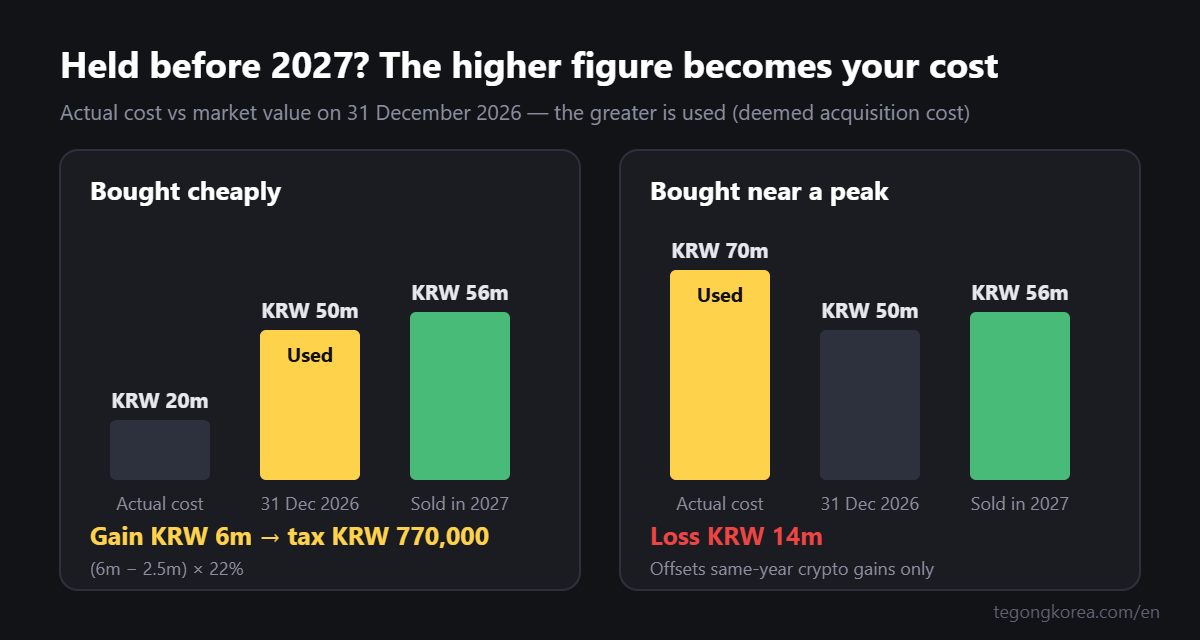
- Bought for KRW 20 million in 2024, worth KRW 50 million on 31 December 2026, sold for KRW 56 million in 2027 → gain KRW 6 million → (6m − 2.5m) × 22% = KRW 770,000.
- Bought for KRW 70 million, worth KRW 50 million on 31 December 2026, sold for KRW 56 million → the KRW 70 million actual cost applies → a KRW 14 million loss.
There is no need to sell and buy back before year-end to lock in the higher basis.
The benefit depends on records
If the actual acquisition cost cannot be established, the rules allow 50% of the sale proceeds to be treated as the cost, which is usually far worse than the real figure. Export full histories from every exchange, including closed ones, keep evidence for offshore and peer-to-peer purchases, and capture holdings as of 31 December 2026. Which exchange prices define the year-end market value is set by the Enforcement Decree and a National Tax Service notice expected in November.
6. Does USDT count?
Yes. Tether is a virtual asset like any other. It tracks the dollar, but its won price moves with the exchange rate and the local premium: roughly USD/KRW × (1 + premium). Buy 1,000 USDT at KRW 1,380 and sell at KRW 1,450, and the KRW 70,000 difference is income, netted with the year’s other crypto results. Swapping a coin into USDT to “park” it is itself a taxable disposal, and selling USDT peer-to-peer for won is a disposal too. The size of that local premium is tracked daily in the Tether premium record.
7. Offshore exchanges are not invisible
- Automatic exchange (CARF): under the OECD’s Crypto-Asset Reporting Framework, participating tax authorities begin exchanging account information in 2027, as set out in the OECD announcement.
- Foreign account reporting: offshore exchange accounts already count as foreign financial accounts. If combined balances exceed KRW 500 million on the last day of any month, they must be reported the following June.
8. A fourth postponement? (as of 24 October 2026)
The tax was first legislated to start in 2022 and has been postponed three times to reach the current 1 January 2027 date. Another delay would be the fourth.
Government
The August tax-reform package contained no deferral, and in late July the finance minister told the National Assembly the tax would proceed as scheduled.
Bills before the National Assembly
- Rep. Park Min-kyu (Democratic Party): align the start with cross-border information exchange, in effect 2029
- Rep. Kim Sang-hoon (People Power Party): two-year deferral
- Rep. Jeong Seong-guk (People Power Party): three-year deferral, to 1 January 2030
- Rep. Song Eon-seok (People Power Party): repeal
Where the parties stand
The People Power Party has adopted deferral as its party line. The Democratic Party is divided but says it will settle the question within the year. The Rebuilding Korea Party opposes any further delay.
Dates to watch
- November: National Tax Service notice on calculating income (issued on the basis of current law), and review by the Assembly’s tax subcommittee
- December: plenary vote on tax bills
- 31 December 2026: the current valuation date for pre-2027 holdings
A deferral would mean no tax on crypto income before the new start date. Whether the 31 December 2026 valuation date would move with it depends on each bill’s supplementary provisions. Either way, records cannot be recreated later.
9. Filing
Income for 2027 is reported and paid during the May 2028 income-tax filing period. Although it is taxed separately, there is no withholding by exchanges for residents: the taxpayer files. Domestic exchanges submit users’ transaction data to the tax authority; offshore, private-wallet and peer-to-peer activity has to be compiled by the holder. The official overview is on the National Tax Service site.
How Korea compares: crypto tax across Asia
Individual (non-business) gains, as of 30 October 2026. Asia splits into three camps: markets that tax gains at income rates, markets that tax the transaction instead of the gain, and financial centres that do not tax capital gains at all.
| Jurisdiction | Individual gains | Status |
|---|---|---|
| South Korea | 22% above a KRW 2.5m annual deduction; separate taxation; losses offset only within the year | Enacted, from 1 Jan 2027; deferral bills pending |
| Japan | Miscellaneous income at progressive rates, top about 55%. A 20.315% separate rate with 3-year loss carry-forward for registered-exchange trades has been legislated | New rate enacted, start expected 2028 (date not yet fixed) |
| India | 30% flat plus surcharge and cess; no loss set-off; 1% TDS on transfers | In force |
| Indonesia | Final tax on the sale value, not the gain: 0.21% on licensed local exchanges, 1% on foreign platforms | In force since 1 Aug 2025 |
| Vietnam | 0.1% on the value of each transfer through licensed pilot providers, withheld by the provider | In force since 27 Mar 2026 |
| Thailand | Gains on sales through SEC-licensed Thai operators exempt; offshore-platform gains not covered (see note below); otherwise progressive 0–35% | Exemption 2025–2029 |
| Philippines | No crypto-specific rule; gains taxed as ordinary income at 0–35% | General rules |
| Taiwan | Onshore sales as property-transaction income (5–40%); offshore gains under the minimum-tax regime | In force |
| Singapore | No capital gains tax; taxed only if trading amounts to a business | In force |
| Hong Kong | No capital gains tax; profits tax only for a trading business | In force |
| Malaysia | Capital gains not taxed for individuals; active trading taxed as income | In force |
| Australia | CGT at marginal rates; 50% discount after 12 months, replaced by indexation for gains from 1 Jul 2027 | In force; reform enacted |
| United Kingdom | CGT 18% or 24%; GBP 3,000 annual exempt amount | In force |
| United States | Property; short-term up to 37%, long-term 0/15/20% plus possible 3.8% surtax | In force |
Note on Thailand: the 2025–2029 exemption covers only sales through SEC-licensed Thai operators. Gains on platforms outside Thailand may, depending on the facts, be treated as foreign-sourced income, which a Thai tax resident generally pays tax on only when the income is brought into Thailand. Where crypto gains are sourced is not settled, and the Revenue Department may take a different view where the seller is in Thailand.
Korea’s rate is unremarkable. What stands out is the low deduction, the absence of loss carry-forward and the dated one-time basis reset. Indonesia and Vietnam show the other route: a small levy on every transaction, collected by the exchange, whether the trade made money or not.
What holders should do before the year ends
- Export full transaction histories from every exchange used, including inactive ones.
- Record holdings and market values as of 31 December 2026, per asset.
- Document private-wallet and peer-to-peer activity: date, quantity, price and transaction hash.
- Set aside cash for tax when swapping, so a liability does not arrive without the won to pay it.
- Check whether offshore balances trigger foreign financial account reporting.
To try your own numbers, use the Korea crypto tax calculator.
Primary sources
Every figure on this page traces back to one of these. Please verify against the original before publishing.
- National Tax Service — taxation of residents' virtual asset income — Official overview of the regime
- Korea Law Information Center — Income Tax Act — Virtual asset income, deduction, rate and the transition rule
- OECD — Crypto-Asset Reporting Framework, first exchanges in 2027
- Hometax — Filing procedures and forms
- Japan NTA — tax treatment of crypto-assets (rev. Dec 2025); MOF FY2026 tax reform outline — Comparison table: Japan
- India Income Tax Department — TDS on transfer of virtual digital assets — Comparison table: India
- Indonesia DJP — PMK 50/2025 on crypto-asset taxation — Comparison table: Indonesia
- Thailand Revenue Department — Ministerial Regulation No. 399 (2025) — Comparison table: Thailand
- Baker McKenzie — Vietnam pilot tax framework for crypto-asset transactions (May 2026) — Comparison table: Vietnam (secondary source)
- IRAS — Income tax treatment of digital tokens — Comparison table: Singapore
- Hong Kong IRD — DIPN 39 — Comparison table: Hong Kong
- Malaysia LHDN — Tax treatment on digital currency transactions (Dec 2025) — Comparison table: Malaysia
- ATO — Capital gains tax reform (Oct 2026) — Comparison table: Australia
- GOV.UK — Capital Gains Tax rates — Comparison table: United Kingdom
- IRS — Digital assets — Comparison table: United States
Related pages
Korean-language version
The same explanation, with a won-denominated calculator, is published in Korean: 코인 세금 250만 원 넘으면 22% 손실 이월 불가.
This page summarises publicly available Korean regulatory and market information. It is not legal, tax, or investment advice. Rules change and enforcement dates shift; always confirm against the primary sources linked on this page before relying on it. Tax outcomes depend on individual circumstances; consult a qualified Korean tax professional before acting.